Operational Support for High-Performing Executives
Leadership, Operational Support, Executive Productivity
Beyond Assistants and Concierge: Operational Support for High-Performing People
Many executives hire support but still feel overwhelmed. The problem usually isn’t the amount of help—it’s the type of support they’ve put around them. This guide reframes how founders and senior leaders should think about support, shifting the conversation from “tasks and titles” to “operations and outcomes.”
The Real Problem: Mismatched Support for a High-Complexity Role
As a founder or senior executive, your work is a blend of urgent decisions, long-term bets, personal logistics, and constant context switching. You may already have a personal assistant, a concierge service, or even an ops generalist—yet your calendar still feels like a game of Tetris, and you’re the one holding the pieces at midnight.
The core issue: most support models were designed for a world where boundaries were clear. Work stayed at the office. “Personal” and “professional” were separate. Today, your life is one integrated operating system. You don’t just need help; you need operational support for a high-performing person.
Concierge vs. Personal Assistant vs. Operational Support: What’s the Real Difference?
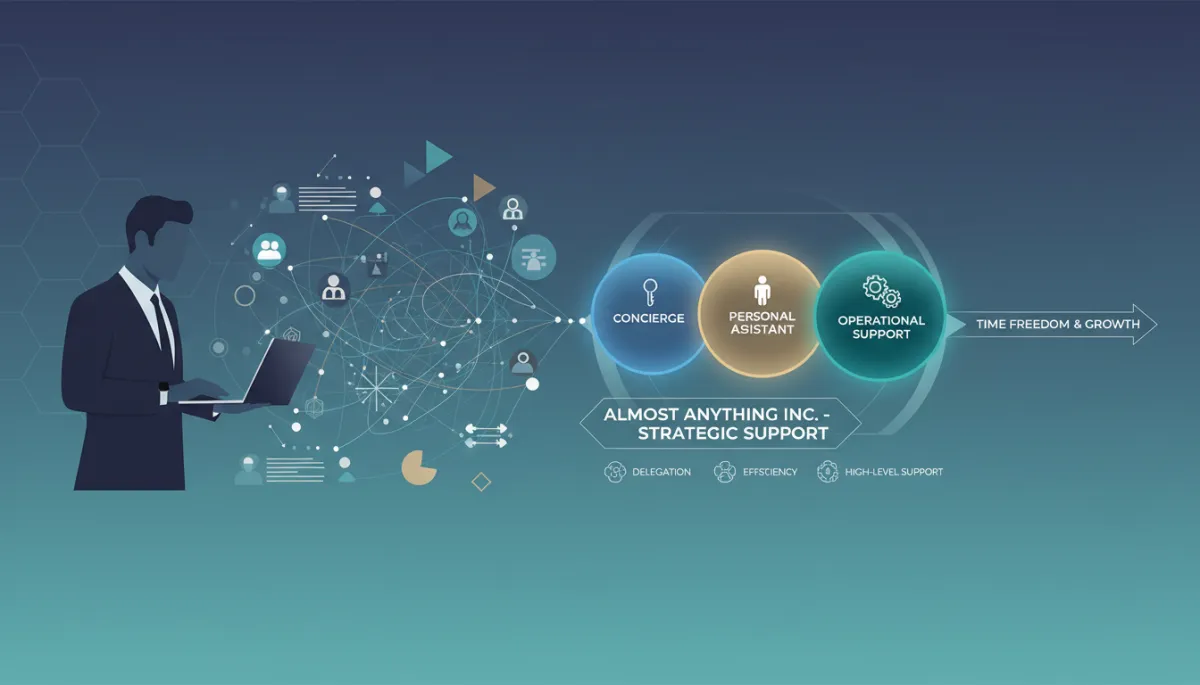
To design the right support architecture, it helps to clarify three categories that often get blurred together: traditional concierge services, personal assistants, and operational support. Each solves a different kind of problem—and each breaks down when used outside its ideal zone.
Traditional Concierge Services: Transactional Convenience
A concierge is built for discrete, well-defined requests. Think: booking restaurants, arranging travel, sourcing a last-minute gift, or finding a dog walker in a new city. The value is speed and access: someone else handles the “find and book” while you stay focused elsewhere.
Scope: Lifestyle and logistics, usually outside the core business engine.
Mode: On-demand, transactional, request–response.
Strength: Convenience and speed for clear, one-off tasks.
Personal Assistants: Calendar, Inbox, and Admin Support
A personal assistant (PA) is typically anchored around administrative and scheduling support. They manage your calendar, coordinate meetings, handle travel details, and filter your inbox. A strong PA keeps you organized and reduces friction around the mechanics of your day.
Scope: Calendar, communication, document prep, light personal tasks.
Mode: Ongoing, relationship-based, but usually task-driven.
Strength: Reducing administrative drag and logistical chaos.
Operational Support: Running the System Around You
Operational support is different. It’s not just about tasks; it’s about designing and running the system that keeps your life and work moving. Think project management, cross-functional coordination, vendor orchestration, follow-through on decisions, and proactive problem solving across both business and personal domains.
Scope: Projects, processes, coordination, and ongoing execution across work and life.
Mode: Strategic, proactive, systems-oriented, outcome-focused.
Strength: Turning your priorities into repeatable, reliable execution.
When a Concierge Works—and When It Doesn’t
Concierge services shine when you know exactly what you need and simply don’t want to spend time sourcing it. You want:
A hard-to-get dinner reservation after a board meeting.
Same-day dry cleaning pickup and delivery before a flight.
Tickets, gifts, or local services in a city you’re visiting once.
In other words, a concierge is ideal for transactional lifestyle wins. Where it breaks down is when your world becomes a web of interconnected projects: moving house while closing a round, coordinating childcare around shifting travel, or aligning your personal schedule with investor meetings and leadership offsites. That’s no longer “book a thing”; that’s run a multi-step operation.
When a Personal Assistant Works—and Where the Ceiling Appears
A strong PA can be transformative when your primary constraint is administrative overload. If your calendar is a mess, your inbox is a liability, and you’re constantly rescheduling calls, a PA is a powerful first move. They stabilize your days and reduce context switching.
But as your role becomes more complex, you run into a structural limit. A PA can schedule your meetings—but who is ensuring the follow-up tasks are tracked, delegated, and completed? A PA can book your travel—but who is orchestrating the project of “two weeks on the road while the rest of your life still runs smoothly”?
That gap is where many executives feel the familiar frustration: “I have an assistant, but I’m still the bottleneck.” You’ve delegated tasks, but not operations.

Systems plus support turn scattered tasks into a predictable operating rhythm.
When Operational Support Becomes Non‑Negotiable
Operational support becomes essential when your life and work behave more like an always-on system than a list of tasks. You need it when:
You’re managing multiple parallel initiatives—fundraising, hiring, product, family logistics—and none can be dropped.
You’re the escalation point for everything, from investor asks to household emergencies.
You can’t afford to spend cognitive energy on “how will this get done?” every time you make a decision.
Operational support is the layer that turns your priorities into coordinated execution. It connects your calendar, your inbox, your projects, your household, and your commitments into one integrated system, so that when you say “yes,” the how is already handled.
Why Modern Executives Need More Than Traditional Support
For modern leaders, the game isn’t “how do I get more done?” It’s “how do I protect my attention for the decisions only I can make?” That requires a support model built around six critical functions: urgent problem solving, operational coordination, personal logistics, executive efficiency, time protection, and lifestyle management.
Urgent Problem Solving
Crises don’t respect your calendar. A flight cancels, a key vendor falls through, a childcare plan collapses on the same day as a board meeting. Traditional concierge services can book alternatives, but they’re not orchestrating the domino effect across your day, your team, and your home life.
True operational support steps in as a problem-solving partner: reworking travel, notifying stakeholders, adjusting agendas, lining up backups, and restoring stability with minimal input from you. This is founder-aware support—understanding what is truly non-negotiable and what can flex.
Operational Coordination
Your world is a network of people and systems: internal team members, external partners, family, advisors, vendors. Operational coordination is the discipline of keeping all of them aligned without you becoming the routing hub for every detail.
This goes beyond a PA forwarding emails. It’s about building and running systems—shared checklists, communication patterns, escalation paths—that allow projects and logistics to advance without constant executive supervision. You decide; your support coordinates; the system executes.
Personal Logistics
For high-performing people, “personal life” is not a separate tab—it’s part of the same operating system. School schedules, medical appointments, household maintenance, family travel, financial admin: when these are unmanaged, they bleed into work hours and drain executive bandwidth.
Modern operational support doesn’t treat personal logistics as an afterthought. It builds structures around them—recurring reminders, vendor relationships, standard operating procedures—so home life runs with the same reliability as a well-run business function. This is how you create time freedom without sacrificing real-life responsibilities.
Executive Efficiency and Time Protection
You don’t need more hours; you need better use of the hours you already have. Executive efficiency is about designing your week so your highest-leverage work gets your best attention. Time protection is about ensuring that design survives contact with reality.
Operational support treats your calendar as a strategic asset, not a scheduling puzzle. It builds rules around meeting types, decision windows, focus blocks, and recovery time. It enforces those boundaries with stakeholders, adjusts intelligently when priorities shift, and ensures that urgent does not constantly override important.
Lifestyle Management as a Performance Lever
For founders and executives, lifestyle isn’t a luxury topic—it’s a performance variable. Sleep, nutrition, exercise, family time, and restoration directly affect your decision quality. Yet these are often the first things sacrificed when the calendar gets crowded.
A modern support model incorporates executive lifestyle management: aligning travel with rest, scheduling workouts you’ll actually make, protecting evenings with family, and ensuring that your environment supports your role. It recognizes that your brain is the core asset—and designs around that reality.
A Strategic Decision Framework: Concierge, PA, or Operational Support?
Instead of asking, “Do I need a concierge or an assistant?” a better question is: “What kind of work am I trying to remove from my brain?” Use this simple framework:
If the work is a clear, one-off transaction with a defined outcome (book, buy, reserve, deliver), concierge support is usually sufficient.
If the work is administrative and recurring (calendar, inbox, travel, documents) and you mainly need organization and responsiveness, a PA is a strong fit.
If the work is multi-step, cross-functional, ongoing, and outcome-driven—projects, coordination, logistics across work and life—you’re in the territory of operational support.
Most high-performing leaders ultimately need a blend: concierge-level convenience, PA-level organization, and operational support as the backbone. The question is not which one to choose, but how to architect a support stack that reflects the complexity of your role.
Almost Anything Inc.: Operational Support for High-Performing People
This is where Almost Anything Inc. is deliberately positioned: not as a traditional concierge, not as a simple PA service, but as a modern operational support partner for founders, executives, and other high-performing people who need more than ad hoc help.
Rather than forcing you to choose between narrow categories, Almost Anything Inc. offers a comprehensive suite of support capabilities that can be configured around your specific operating reality:
Concierge Services for fast, reliable execution on lifestyle and logistics—from bookings and purchases to sourcing and arrangements—handled with the judgment level you’d expect from a senior team member.
Personal Assistant Support for calendar management, inbox triage, travel coordination, and documentation, so the mechanics of your workday are handled without constant oversight.
Operational Support for projects, cross-functional coordination, vendor management, and ongoing execution across both business and personal domains.
Executive Lifestyle Support to align your routines, environment, and commitments with the performance your role demands.
Business Coordination Support to bridge the gap between your decisions and the operational follow-through—ensuring meetings, initiatives, and relationships convert into tangible outcomes.
Underneath these offerings is a single idea: build systems of delegation around you, so that your time and attention are spent where they create disproportionate value. It’s not about doing “almost anything” for the sake of it. It’s about designing a support environment where almost everything that doesn’t require your judgment can be handled without you.
Delegation, Systems, and Founder Efficiency: The Real Levers
For founders and senior leaders, the constraint is rarely raw capability. It’s bandwidth and system design. You know what needs to happen; the challenge is ensuring it happens without you personally pushing every domino. Effective operational support rests on three core pillars: delegation, systems, and time freedom.
Delegation as Design, Not Dumping
Many executives experience delegation as “I hand off a task and then answer questions about it for three days.” That’s not delegation; that’s distributed to-do lists. True delegation is about transferring ownership of outcomes, supported by clear context and guardrails.
Almost Anything Inc. is built to receive work at the level you think: “Here’s the objective, here are the constraints, here’s what good looks like.” From there, operational support translates that into steps, owners, and timelines—so your role is to define direction, not micromanage motion.
Systems That Reduce Decision Fatigue
Every unstructured area of your life creates friction: “How do we book travel?” “Who handles this kind of issue?” “What’s the process when X goes wrong?” Systems are simply pre-decisions that save you from rethinking the same problem repeatedly.
Operational support from Almost Anything Inc. focuses on building these systems around you—templates, checklists, playbooks, communication patterns—so that the support you receive gets sharper and more efficient over time. Founder efficiency is no longer dependent on heroic effort; it becomes a function of design.
Time Freedom as a Strategic Outcome
Time freedom isn’t about working less for the sake of it. It’s about having the option to allocate your time where it matters most: deep work, key relationships, critical decisions, or simply rest when your brain needs it. Without operational support, that option doesn’t exist—you are chained to the small gears that keep your world turning.
By integrating concierge services, PA support, operational execution, lifestyle management, and business coordination, Almost Anything Inc. is designed to create exactly that: time freedom backed by reliable systems, not wishful thinking.
Conclusion: A Modern Operational Support Layer, Beyond Traditional Categories
If you’re a busy executive or founder who has already hired help and still feels overwhelmed, the issue is unlikely to be effort or intent. It’s that your support stack was built for a simpler world: one where concierge services, personal assistants, and “someone to help” were enough. Today, your role demands operational support for a high-performing person—a system, not just a service.
Traditional concierge offerings handle transactions. Personal assistants handle administration. Both are valuable, but neither is designed to run the integrated, always-on operating system that surrounds a modern executive life. That’s the gap Almost Anything Inc. was built to fill: a comprehensive, modern operational support solution that combines concierge convenience, PA structure, executive lifestyle support, and business coordination into one cohesive layer around you.
The result is not just fewer tasks on your plate. It’s a different way of operating: clear delegation, robust systems, protected time, and a support environment that understands the realities of building and leading at a high level. Instead of choosing between “concierge” or “assistant,” you can choose something more strategic: operational support designed for how high-performing people actually live and work.