

Design Your Day: Effective Executive Time Management Tips
How Executives Design Their Time: Executive Productivity Techniques and High-Performance Scheduling Strategies

Executive leadership demands more than managing a to-do list. Today’s top leaders move beyond reactive task juggling to deliberate time design: a strategic approach that reserves attention for high-impact work. This article lays out practical ways executives can redesign their calendars — from calendar blocking and time batching to smarter delegation and concierge support — so they spend less time firefighting and more time advancing strategic priorities.
Key Takeaways
Shifting from reactive time management to proactive time design measurably improves executive productivity.
Time design helps leaders prioritize high-impact work tied to strategic goals and eases pressure and overload.
Calendar blocking carves out focused periods that reduce interruptions and cut multitasking.
Time batching groups like tasks to limit context switching and boost throughput.
Smart delegation reclaims hours by matching tasks to team strengths and clear expectations.
VIP assistants and concierge services handle routine logistics so executives protect strategic bandwidth.
Reliable routines — morning rituals and weekly reviews — help sustain consistent high performance.
Track KPIs such as time on high-value work and task completion to refine your time system.
Regular feedback loops and small adjustments keep time design practices improving over time.
The Shift to the "Superfluid Enterprise"
Traditional time management is often a defensive game, played by reacting to the loudest notification. In 2026, the elite tier of leadership has moved toward Superfluidity. In a Superfluid Enterprise, an executive’s schedule is designed to ensure that talent, data, and decisions flow across the organization without friction or traditional bureaucratic "clogging."
This shift requires a move away from functional silos toward Enterprisewide Accountability. In this framework, the leader’s calendar is no longer a destination where projects go to wait for approval; instead, it serves as a high-velocity catalyst for AI-Driven Execution. By designing your time through this lens, you ensure that your presence is reserved for high-leverage "unlocks," allowing the rest of the organization to maintain momentum autonomously. When an executive achieves this level of time design, they stop being a bottleneck and start being the engine of organizational agility.
Combating "Burn-On" through Psychological Safety
High-performance scheduling is no longer just about maximizing output; it is about sustaining the leader's internal battery. In 2026, the executive suite has identified a new risk: "Burn-On." Unlike traditional burnout, where a leader completely stalls, Burn-On is a state of high-functioning exhaustion—staying productive and visible while internally depleted and disengaged.
To combat this, elite time design incorporates Human-First Thinking. This means intentionally scheduling "recovery sprints" and "white space" that are as non-negotiable as a board meeting. Protecting this time fosters a culture of Psychological Safety; when a CEO models that their value isn't tied to 24/7 connectivity, it empowers the entire organization to prioritize clarity over busy-work.
Furthermore, top executives are now replacing standard networking with Challenge Networks—designated blocks of time for peers and trusted advisors to stress-test their strategic assumptions. By scheduling these sessions, leaders ensure they are not just working hard, but working on the right things, protected by a system that values mental resilience as much as ROI.
Why Do Executives Shift From Traditional Time Management to Time Design?
Moving from classic time management to time design is a shift in mindset. Traditional methods often react to incoming demands, creating distraction and inefficiency. Time design flips that script: it starts with priority, then structures the day to protect those priorities. The result is clearer focus, fewer crises, and more progress on strategic objectives.
Designing your schedule intentionally mirrors research showing that executive strategies shape how cognitive resources are allocated during planning and problem-solving.
Executive Strategies for Resource Allocation & Planning
This note explores how executives choose strategies that allocate cognitive resources during problem-solving. It examines an opportunistic model of executive strategies and tests predictions about performance on an errand-planning task, highlighting flexibility in approach.
Flexibility in Executive Strategies, 1980
What Are the Limitations of Reactive Task Handling?
Reactive work makes urgent items dominate the day, pushing out important long-term work. That pattern leads to missed deadlines, chronic stress, and little progress on strategic initiatives. In practice, executives who react constantly end up extinguishing fires instead of building forward momentum.
How Does Proactive Schedule Design Enhance Executive Productivity?
Proactive schedule design protects blocks of time for priority work so leaders can do deep, uninterrupted thinking. By reserving focused hours for strategy, planning, or complex problem-solving, executives reduce interruptions and boost the quality and speed of outcomes. The discipline of blocking time also creates predictability across teams.
From Static Blocking to "Dynamic Time Orchestration"
The 2026 executive landscape has moved past the era of the rigid, color-coded calendar. Static blocking has evolved into Dynamic Time Orchestration, a system where the schedule is no longer a fixed script but a living, breathing map. This shift is powered by Agentic AI—autonomous digital partners that don’t just "store" your appointments but actively manage the logistics of your life.
Unlike traditional scheduling tools, Agentic AI operates with Zero-Touch Logistics. If a flight delay occurs at Heathrow or Charles de Gaulle, the system doesn't just notify you; it proactively re-orchestrates your entire day. It shifts your deep-work blocks, moves your 1-on-1s based on stakeholder availability, and updates your ground transport and hotel check-in—all without a single manual input from you. This allows the executive to stay in a "flow state" regardless of external chaos. By automating the friction of travel and scheduling, Dynamic Orchestration ensures that your cognitive energy is never wasted on "admin-level" problem solving, preserving your full mental bandwidth for high-stakes strategic maneuvers.
Enabling the "Phygital" Workflow
The modern executive no longer works in a purely physical or purely digital space; they operate in a Phygital environment—a seamless, high-speed integration of global travel and digital influence. Mastering this workflow is the hallmark of the 2026 leader. It requires a relentless focus on the Digital Employee Experience (DEX), ensuring that the technology stack supporting the executive is as frictionless as a VIP lounge at Miami International.
To maintain this edge, top-tier leaders are increasingly utilizing Reverse Mentoring. By scheduling regular sessions with digital-native team members, executives stay ahead of emerging AI tools and decentralized platforms. This allows the leader to delegate the technical "how-to" of the Phygital workspace to their support team, preserving their own Cognitive Load for the "strategic-why." When the physical world presents friction—such as navigating customs or baggage logistics—the Phygital executive relies on their digital infrastructure and concierge partners to maintain a "Continuous Presence", ensuring that leadership impact isn't tied to a specific desk or time zone.
New KPIs—"Time-to-Insight" and "Enablement Ratios"
In 2026, the metrics for executive success have moved beyond simple task completion or hours logged. Productivity is now measured by Time-to-Insight—the specific delta between receiving a complex data stream and synthesizing it into a definitive strategic decision. High-performance time design aims to shrink this window by filtering out the noise of "vanity metrics" and focusing exclusively on Measurable Execution.
A second critical metric is the Enablement Ratio. This measures how effectively an executive’s schedule empowers their direct reports to operate via Strategic Localization—the ability for teams to make high-level decisions at the point of impact without needing a "sign-off" from the C-suite. By tracking these KPIs, leaders can determine if their time design is actually working or if they are simply being "efficient" at the wrong things. Ultimately, the goal is to shift from a focus on engagement (how much you are doing) to enablement (how much your organization can do because of how you’ve designed your time).
How Do Executives Prioritize High-Value Activities Effectively?
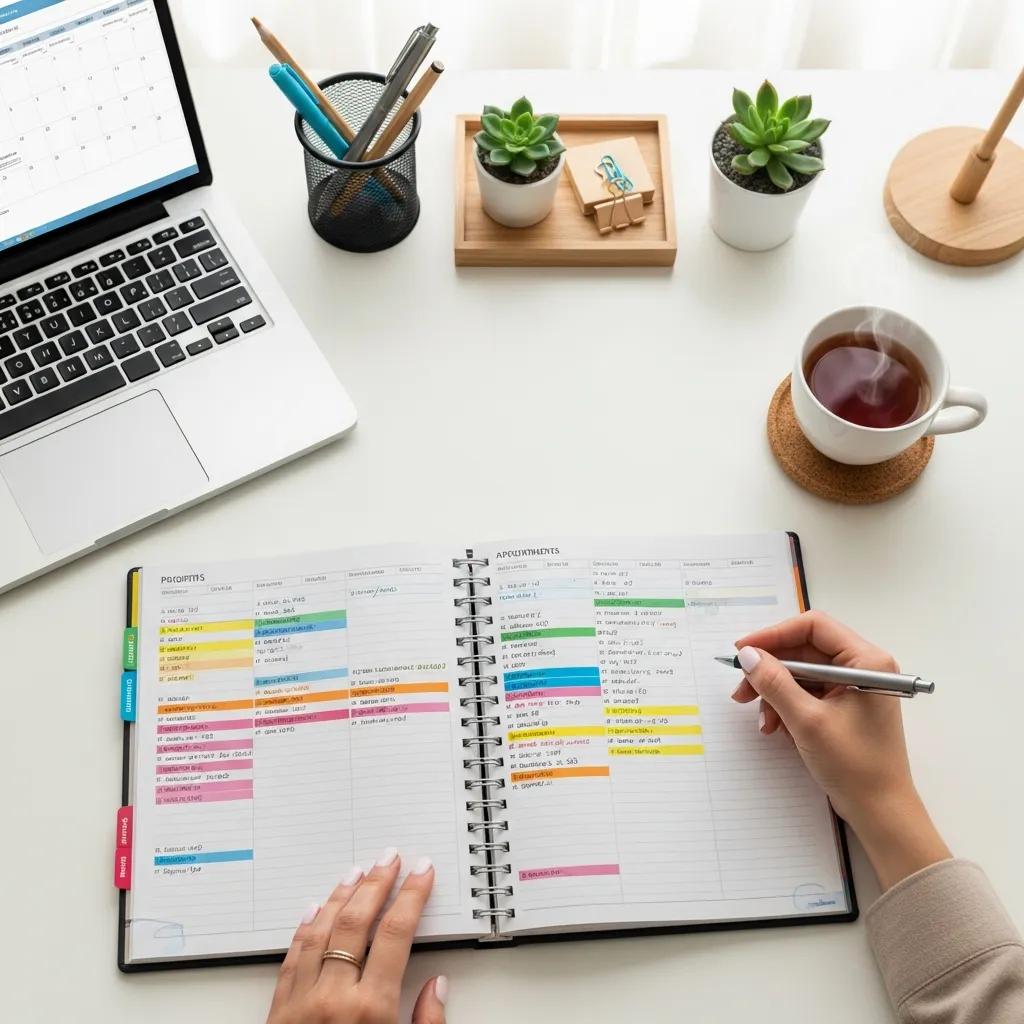
Prioritizing high-value activities starts with clear criteria and alignment to strategic goals. Executives evaluate tasks by impact and urgency, then protect the work that drives the most value. how we work
What Criteria Define High-Value Tasks for Executives?
High-value tasks are those that move strategy forward: they align with long-term objectives, create measurable results (for example, revenue or team performance), or remove bottlenecks. Use these criteria to decide what stays on your plate and what gets delegated or deferred.
How Does Prioritization Impact Overall Time Management Strategy?
Prioritization creates a decision framework that guides scheduling, delegation, and resource allocation. When priorities are clear, it’s easier to say “no” to distractions, allocate time deliberately, and set expectations with teams — all of which increase organizational effectiveness.
What Are the Best Calendar Blocking and Time Batching Methods for Executives?
Calendar blocking and time batching are complementary tools that bring structure to an executive day. Used consistently, they reduce friction and protect cognitive energy for the work that matters most.
How Does Calendar Blocking Improve Focus and Productivity?
Calendar blocking assigns specific slots to distinct activities so you can work with intention. Blocking two hours for strategic planning or an uninterrupted creative session prevents meetings and messages from fragmenting your attention — and leads to deeper, faster progress.
What Are the Benefits of Time Batching in Executive Scheduling?
Time batching groups similar tasks together — like email, meetings, or reviews — to minimize context switching. Batching increases speed and reduces mental fatigue, letting you handle routine work in concentrated bursts while preserving blocks for high-value efforts.
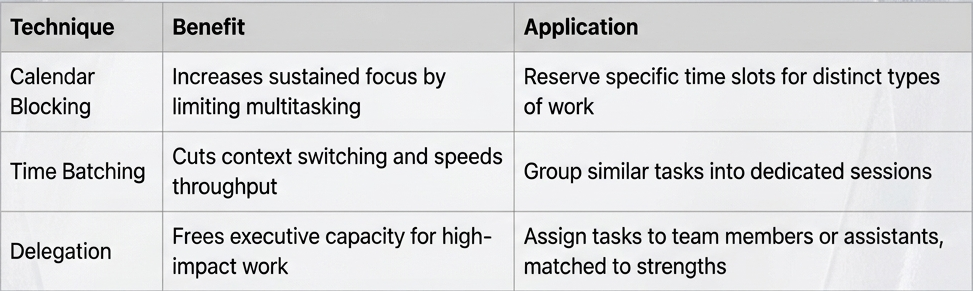
These methods show how predictable structure in the calendar translates into measurable productivity gains.
How Do Delegation and Personal Assistant Services Protect Executive Time?

Delegation and support services are essential levers for preserving an executive’s focus. When routine work is redistributed, leaders can concentrate on decisions and relationships that move the organization forward. work with us
What Delegation Techniques Maximize Executive Efficiency?
Effective delegation pairs tasks with the right people, clarifies expected outcomes, provides necessary resources, and sets accountability. Empowered team members who own tasks reduce handoffs and create reliable results — unlocking time for leaders to do higher-level work.
How Do VIP Assistant and Concierge Services Enhance Time Design?
VIP assistants and concierge services manage logistics and routine demands — scheduling, travel, and vendor coordination — so executives keep their focus on strategic priorities. Outsourcing these tasks preserves attention and reduces decision fatigue across the week.
What Are Real-World Examples of Executive Daily and Weekly Time Structures?
Looking at confident daily and weekly rhythms helps translate principles into practice. High-performing leaders use repeatable structures that make progress reliable and sustainable. About us
How Do Executives Structure Their Days for Maximum Productivity?
Many executives start with a morning ritual: a brief review of goals, priority-setting, and an early block for deep work. After that, they group meetings and administrative tasks into predictable windows, protecting other parts of the day for uninterrupted focus.
What Weekly Scheduling Patterns Support Sustained High Performance?
Weekly patterns often include a dedicated planning session to review priorities, assess progress, and reallocate time. Regular touchpoints for reflection and course correction keep work aligned with longer-term goals and prevent drift.
How Can Executives Measure and Optimize Their Time Design Systems?
To improve a time design system, measure outcomes and iterate. Capture where time goes, compare it to priorities, and make adjustments driven by data and feedback.
What Key Performance Indicators Track Executive Productivity Gains?
Useful KPIs include completion rates for priority tasks, proportion of time spent on high-value activities, and measures of meeting efficiency. Regularly reviewing these metrics reveals friction points and opportunities to reallocate time to higher-impact work.
How Does Feedback and Adjustment Improve Time Management Strategies?
Feedback — from peers, direct reports, and self-reflection — surfaces blind spots and helps refine habits. Combine input with small experiments and you’ll continually improve how time is designed and defended.
Frequently Asked Questions
What are some common challenges executives face when implementing time design strategies?
Leaders often wrestle with old habits, the pressure of constant interruptions, and the discomfort of delegating. Other hurdles include unclear priorities, inconsistent team buy-in, and unexpected demands that disrupt schedules. Address these by setting clear rules, communicating boundaries, and iterating until the new rhythm sticks.
How can technology assist executives in optimizing their time management?
Technology streamlines scheduling, prioritization, and delegation. Calendar tools support blocking; task platforms track progress and handoffs; and automation reduces repetitive work. Combined, these tools help maintain structure and free cognitive bandwidth for strategic work.
What role does self-care play in effective time management for executives?
Self-care directly supports decision-making and resilience. Regular exercise, sleep, and short restorative breaks sustain attention and reduce burnout. When well-being is scheduled and protected, performance and clarity improve. About us
How can executives ensure their time management strategies align with their organizational goals? 4
To align time strategies with company goals, set measurable priorities and review them regularly with your team. Communicate expectations, map key activities to strategic outcomes, and use weekly reviews to stay on course. That keeps individual schedules tethered to organizational impact.
What are some effective ways to track progress in time management initiatives?
Track progress with KPIs like time on strategic work, task completion rates, and meeting effectiveness. Combine quantitative data with periodic qualitative reviews and reflective journals to spot patterns and adjust practices.
How can networking and collaboration enhance executive time management?
Networking and collaboration provide access to shared tools, best practices, and shortcuts. Peer exchanges surface efficient approaches, while cross-functional collaboration can streamline decision-making and reduce duplicated effort — freeing time for higher-value work.
About the Author
Almost Anything Inc. is a leading consultancy specializing in executive productivity and organizational design. With a focus on innovative time management strategies and high-performance leadership, Almost Anything Inc. partners with top executives worldwide to transform how they design their time and drive strategic impact.
Conclusion
Designing your time intentionally lets you do the work that matters most. By applying calendar blocking, batching, delegation, and targeted support, executives regain focus, lower stress, and drive better results. Use the strategies here as a starting point: measure outcomes, iterate, and protect the time that advances your strategy.