

Elevate Your Leadership: Delegation Strategy as a Strength
Master Delegation—Guilt‑Free

Delegation is a strategic leadership lever — not a checkbox or an optional admin task. For busy founders and executives, smart delegating frees time for high‑value strategy, accelerates team capability, and improves outcomes. Still, many leaders treat delegation as risky or interpret it as weakness. This guide flips that script: we’ll bust common myths, show the warning signs that you’re a bottleneck, and give practical, low‑friction steps to delegate without trading off quality. You’ll walk away with a simple prioritization framework and a ready‑to‑use checklist.
That resistance rarely reflects reality — it’s usually guilt, the reaction many founders report when they hand work to others.
Founders, Guilt, and Delegating Tasks to Teams
Many founders report a strong sense of personal responsibility and guilt when deciding whether to pass work to co‑founders or employees — a pattern that can shape major startup choices and outcomes.
Understanding startup failure: the impact of founders' personality and experiences on the decision to cease operations, 2024
Why Is Delegation a Core Leadership Competency, Not a Weakness?
Delegation is the mechanism leaders use to multiply their impact. By assigning the right work to the right people, leaders reclaim time for strategy and open development pathways for others. Delegation signals trust, clarifies roles, and strengthens a collaborative, resilient organization. Done well, it boosts results and creates room for innovation.
How Does Delegation Enhance Leadership Effectiveness and Operational Efficiency?
When leaders offload executional work, they can focus on direction, partnerships, and decisions only they can make. Teams that practice disciplined delegation see measurable gains in engagement and throughput — one Harvard Business Review analysis suggests delegating leaders can lift team output by up to 33%. The return is both operational (faster delivery) and cultural (more ownership across the team).
What Recent Statistics Prove Delegation’s Impact on Founder and Executive Success?
Multiple surveys and studies link intentional delegation to stronger outcomes. The Project Management Institute finds that 70% of successful project managers credit delegation for their results. Organizations that normalize delegation often report a 20–25% lift in overall productivity. Put simply: delegation is less a soft skill and more a strategic advantage.
What Are the Most Common Delegation Myths Leaders Should Debunk?

Why Is Delegation Not a Sign of Weakness or Losing Control?
Delegation doesn’t dilute your control — it focuses it. Handing off responsibility demonstrates trust and frees you to prioritize the work only you should do. Leaders who delegate effectively are typically stronger at resource management and decision‑making because they concentrate on impact rather than getting bogged down in executional detail.
How Do Leaders Overcome Fears of Failure and Burdening Others?
Fear of handing off work usually comes from vague expectations or missing processes. Reduce that fear by defining outcomes, setting clear boundaries, and supplying the right resources up front. Treat delegation as coaching: set the objective, agree checkpoints, and give the team the autonomy to deliver. Over time this builds capacity and lowers the apparent cost of delegating.
What Are the Signs That a Leader Is Becoming a Bottleneck?
Which Behaviors Indicate Task Hoarding and Decision Delays?
Common red flags include: you keep tasks others could own, you delay decisions waiting for your sign‑off, or your inbox dictates your day. Those behaviors slow projects and leave capable people underused.
The leadership-bottleneck effect is well documented and often undermines organizational effectiveness.
Leadership Bottlenecks: Impeding Effectiveness
Groups can internalize narrow ideas about leadership that create bottlenecks — shared assumptions about “who decides” that reduce leadership diversity and limit effectiveness.
The bottleneck metaphor of leadership culture: How shared understandings about leadership develop in groups and impede diversity and effectiveness of leaders, M Özcan, 2021
How Does Bottlenecking Affect Team Morale and Productivity?
Bottlenecks damage both speed and morale. When leaders hang on to work, team members feel underused and disengaged, and output drops. Gallup data shows teams with engaged leaders are roughly 21% more productive — another reason to treat delegation as a tool for motivation and sustained performance.
How Can Leaders Delegate Without Losing Quality or Control?
What Are the Step-by-Step Best Practices for Effective Delegation?
Identify Tasks to Delegate: Audit your workload and flag tasks that don’t require your unique authority or experience.
Set Clear Expectations: Define outcomes, timelines, scope, and any non‑negotiables before handing the work off.
Provide Resources and Support: Give tools, context, and decision rules so the person taking the task can succeed.
Monitor Progress: Agree on checkpoints and feedback rhythms instead of micromanaging — step in only when needed.
How Does Clear Communication and Feedback Maintain High Standards?
Clarity up front and timely, constructive feedback during the work keep standards high. Frame feedback as learning: note what worked, what didn’t, and the next steps. That routine cements expectations and speeds competence, so you can delegate more without losing quality.
How Do You Build Trust and Accountability in Delegation?
What Strategies Foster Transparency and Empowerment Among Teams?
Promote transparency by explaining why a task matters and how it links to bigger goals. Give people ownership and the authority to make decisions inside agreed boundaries. Invite their input on approach — that boosts buy‑in and often surfaces practical improvements. how we work
How Does Accountability Drive Ownership and Performance?
Accountability connects work to outcomes. Use measurable goals, visible progress markers, and regular check‑ins to make responsibilities clear. When people see the impact of their work, they take initiative — and performance improves.
What Is a Simple Framework for What Busy Executives Should Delegate First?
How Does the Eisenhower Matrix Adapt to Delegation Priorities?
The Eisenhower Matrix makes it easy to decide what to keep and what to pass on. Sort tasks into four quadrants:
Urgent and Important: Handle personally — mission‑critical and time‑sensitive.
Important but Not Urgent: Prime candidates for delegation with clear milestones.
Urgent but Not Important: Delegate immediately to free time for higher‑value work.
Neither Urgent nor Important: Eliminate or defer — these rarely need your attention.
What Are Actionable Examples of Tasks to Delegate for Founders and Executives?
Delegation candidates include: work with us
Administrative Tasks: Calendar management, travel booking, and email triage — hand these to an assistant or operations partner.
Project Management: Name project leads to own timelines and delivery so you can focus on strategy.
Research and Analysis: Delegate data collection and preliminary analysis to analysts or associates and review the conclusions.
What Is Your Ultimate Delegation Checklist for Immediate Implementation?

Which Key Steps Ensure Successful Delegation Every Time?
Assess Task Suitability: Confirm the task can be owned by someone else and won’t need your unique approvals.
Select the Right Person: Match the task to skills, capacity, and development goals.
Communicate Clearly: Share desired outcomes, deadlines, and decision limits.
Follow Up: Schedule short check‑ins and be available for clarifying questions.
How Can Leaders Monitor and Adjust Delegation for Continuous Improvement?
Track outcomes and capture brief feedback after each handoff. Use those notes to tighten instructions, adjust support, and expand responsibilities. Small, regular iterations scale team capability and reduce the need for your direct oversight over time.
Mastering delegation lets founders and executives operate at the level where they create the most value. Debunk the myths, watch for bottlenecks, and apply the practical steps above to build a culture of trust and accountability. Use the Eisenhower Matrix to sort what to delegate and follow the checklist to protect quality. Start small, iterate often, and reclaim the time to focus on the decisions only you can make.
The Strategic Guide to Operational Efficiency through Delegation
The Delegation Strategy: Scaling Beyond the Founder
In the world of high-growth entrepreneurship, a delegation strategy is the difference between a stagnant company and a market leader. True operational efficiency is achieved when a leader stops being a technician and starts being an architect. To improve operational efficiency, you must treat your workforce as a pool for resource allocation, not just a collection of task-takers.
Busting the Myths of Micromanagement
Many leaders fear that letting go leads to waste or a loss of organization. In reality, micromangement is the primary driver of high employee turnover and low job satisfaction. When you fail to delegate tasks, you create complexity that stalls business growth.
The ROI of Effective Delegation
Improving operational efficiency is not just about speed; it's about operating costs and operating expenses. By utilizing automation and modern software, you can offload repetitive business process steps.

5 Pillars of Operational Excellence
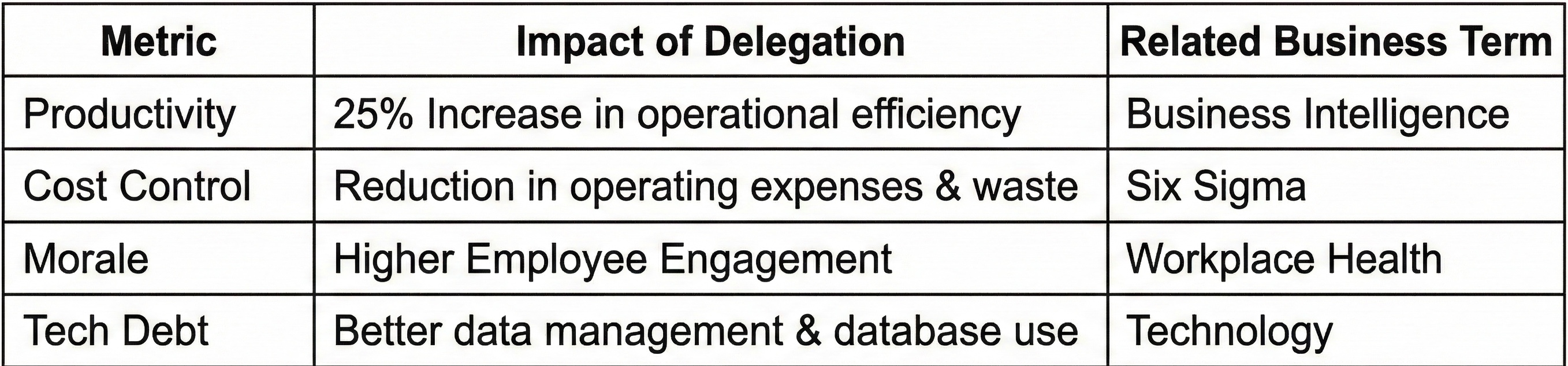
Automation & Technology: Use software to handle inventory tracking and procurement. Automation reduces human error and lowers operating costs. Data-Driven Decisions: Use data analysis and business intelligence to identify which business process is failing. High complexity in a database or data management system often signals a need for better organization. Customer-Centricity: When you delegate tasks related to customer service, you empower your employee to improve the customer experience directly, leading to higher income. Waste Reduction: Apply Six Sigma principles to eliminate waste in manufacturing and maintenance. Every hour you spend on maintenance that a workforce member could do is a loss in operational efficiency. Resource Allocation: Smart resource allocation ensures that your technology stack and personnel are aligned with your goal setting.
The Ultimate Delegation Checklist for the Modern Business
Assess Complexity: Is the task a routine business process or a high-level delegation strategy?
Audit Software: Can automation or specific software handle this inventory or data analysis?
Monitor Health: Does this handoff improve workplace culture and job satisfaction?
Track Income: Does freeing up your time lead to higher income and lower operating expenses?
Review Maintenance: Ensure maintenance of technology and database systems is delegated to specialists to avoid waste.
Frequently Asked Questions
How can leaders effectively communicate their delegation intentions to their teams?
Be explicit about purpose, outcomes, and timelines. Explain why the work matters and how it links to broader goals, then invite questions. That transparency builds trust and makes expectations clear. Whenever possible, treat the handoff as a two‑way conversation so the person taking the work feels informed and invested.
What are some common mistakes leaders make when delegating tasks?
Typical errors include vague instructions, no measurable goals, and failing to check in. Skipping training or resources and slipping into micromanagement are also frequent pitfalls. Avoid these by defining clear success criteria, agreeing check‑ins, and providing the support people need to succeed.
How can leaders measure the success of their delegation efforts?
Look at both outcomes and behaviours: project completion rates, on‑time delivery, and team engagement. Collect feedback from those doing the work and track whether tasks move off your plate over time. Regular reviews will reveal whether delegation is improving capacity and performance.
What role does trust play in the delegation process?
Trust is central — it lets you hand off work with confidence and gives people the psychological space to own outcomes. Build trust by setting clear expectations, supporting people when needed, and recognizing their wins. Over time, demonstrated competence earns greater autonomy.
How can leaders address resistance from team members when delegating tasks?
Understand the root cause: fear of failure, unclear scope, or overload. Discuss concerns, clarify support, and show how the task connects to growth or impact. Involving team members in planning increases buy‑in and reduces pushback.
What are some effective ways to provide feedback after delegating tasks?
Make feedback specific, timely, and balanced. Start with what worked, then address gaps and agree next steps. Encourage team members to reflect on their own performance — that reinforces learning and speeds future handoffs.
What are the key benefits of effective delegation for leaders?
Effective delegation frees leaders to focus on high‑impact work, grows team capacity, and reduces burnout. It also develops talent and builds a culture of ownership that improves productivity and decision speed.
How can leaders identify which tasks to delegate?
Audit your tasks and ask: Does this require my authority or unique expertise? If not, and someone on the team can do it or learn it, delegate. Use the Eisenhower Matrix to prioritize important‑but‑not‑urgent and urgent‑but‑not‑important tasks for delegation.
What role does feedback play in the delegation process?
Feedback speeds learning and preserves quality. Give clear, timely feedback tied to outcomes and next steps. Treat each delegation as a coaching opportunity to reduce future oversight. about
How can leaders overcome the fear of losing control when delegating?
Start with small, low‑risk tasks and set firm guardrails. Use agreed checkpoints instead of continuous review, and treat early mistakes as learning moments. Expand delegation incrementally as trust and competence grow.
What strategies can leaders use to build accountability in their teams?
Clarify responsibilities, set measurable goals, and make progress visible. Regular check‑ins, written expectations, and recognition for ownership reinforce accountability and consistent performance. how we work
How can leaders ensure quality is maintained during delegation?
Set explicit success criteria, provide the right tools, and agree on review points. Give constructive feedback and adjust support as needed — quality improves when expectations and resources align.
About the Author
Almost Anything Inc. is a leading consultancy specializing in leadership development and organizational effectiveness. With a focus on practical strategies and actionable insights, Almost Anything Inc. empowers founders and executives to maximize their impact through smart delegation and team empowerment.
Conclusion: The Entrepreneurship Leap
Mastering delegation skills is the ultimate tool for entrepreneurship. By focusing on improving operational efficiency, you reduce complexity and foster a company culture of Employee Engagement. Don't let your organization suffer from the waste of underutilized talent. Use technology, embrace Six Sigma, and turn your business into a high-output machine.