
Core Capacity Guide: Manage Time & Energy
Capacity Management, Invisible Labor, Delegation, Lifestyle Management
Core Capacity Application Guide
This Core Capacity Application Guide is a practical companion to the Capacity Equation—helping you move from understanding that capacity is limited to actively protecting it in your daily life and work.
Protect Your Time, Energy, and Focus
Apply the Capacity Equation to reduce invisible labor and reclaim attention
What Is the Core Capacity Framework?
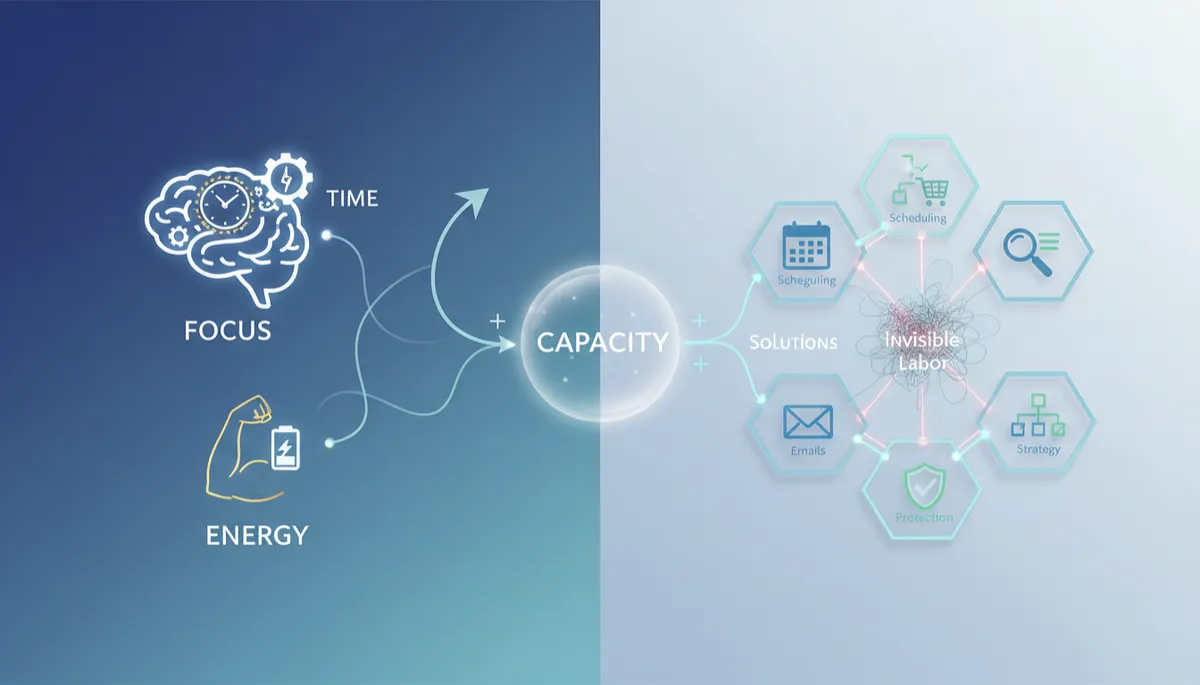
The Capacity Equation—introduced in Almost Anything Inc.’s thought leadership on the Invisible Labor Crisis—defines capacity as: Capacity = Time + Energy + Focus. It is a conceptual framework, not a mathematical formula. The goal is not to calculate a number, but to give you a clear lens for evaluating how your responsibilities draw on three essential resources:
Time — the actual hours available in your day and week.
Energy — your mental, physical, and emotional bandwidth to engage with what matters.
Focus — the uninterrupted attention you can give to meaningful priorities.
Two people can have identical calendars yet dramatically different capacity. Invisible labor—coordination, follow‑through, remembering, monitoring—quietly consumes time, drains energy, and fragments focus. This guide shows you how to use the Capacity Equation as a diagnostic tool so you can see where your capacity is going and what to do about it.
Why Capacity Needs to Be Managed, Not Assumed
High‑performing professionals often assume that if something fits on the calendar, they have capacity for it. The Invisible Labor Crisis—explored in Almost Anything Inc.’s press release and articles—shows why that assumption fails. Responsibilities that never appear as appointments still consume meaningful capacity:
Time — scheduling, researching options, coordinating vendors, managing returns, arranging travel, handling deliveries, and more.
Energy — repeated decision‑making, solving small but persistent problems, managing unexpected issues, and carrying responsibility for others’ needs.
Focus — tracking unfinished tasks, monitoring deadlines, thinking about household logistics while in a board meeting, or mentally switching between professional and personal roles.
This invisible labor is difficult to see precisely because it happens in the background. The Capacity Equation brings it into view and gives you a structure for deciding what you should personally carry—and what can move elsewhere through delegation or professional support such as the services offered by Almost Anything Inc..
Start With a Capacity Check
Before you can protect your capacity, you need to understand where it is currently being spent. Think of this as a quick diagnostic—your personal Capacity Check. Instead of asking “Do I have time?”, you ask more precise questions about time, energy, and focus.
Time Check: Where Are the Hours Going?
What tasks are consuming the most hours each week?
Which responsibilities repeatedly appear on my schedule (meetings, commuting, errands, vendor visits, travel planning)?
What tasks take longer than they should because they require coordination or back‑and‑forth communication?
Which activities could someone else reasonably handle if given the right instructions and authority?
Energy Check: What Leaves You Drained?
Which responsibilities leave me mentally or emotionally exhausted, even when they do not take much time?
Where am I making repeated decisions—choosing vendors, comparing options, resolving small issues?
Which tasks cause stress or low‑level anxiety because they are easy to forget but important to complete?
What am I constantly thinking about, even when I am not actively doing it?
Focus Check: What Interrupts Your Attention?
What repeatedly interrupts my concentration—calls from vendors, texts about deliveries, reminders about appointments?
Which responsibilities live in the back of my mind while I am trying to focus on deep work or family time?
What unfinished tasks or loose ends distract me throughout the day?
What do I keep remembering at inconvenient times—on the commute, in a meeting, late at night?
💡 Pro Tip: Capture your answers in writing for one week. The goal is not to create a perfect list, but to make invisible labor visible enough to work with.
Build Your Capacity Inventory
Once you have a sense of where your time, energy, and focus are going, the next step is a Capacity Inventory—a structured list of recurring responsibilities across your life. This is not just a to‑do list; it is a map of what you carry.
Use the following categories as a starting point and customize as needed:
Work — meetings, emails, projects, business travel, client responsibilities, board commitments, professional associations.
Home — repairs, maintenance, cleaning, household vendors, deliveries, seasonal projects, service contracts.
Personal — appointments, health care, errands, shopping, returns, reservations, renewals (licenses, memberships).
Family — schedules, school and activities, medical appointments, events, celebrations, caregiving responsibilities.
Property — maintenance, contractors, inspections, repairs, vendor coordination across primary and secondary residences or investment properties.
Travel — flights, hotels, transportation, reservations, itineraries, pre‑trip preparation, and post‑trip catch‑up.
For each recurring responsibility, ask:
Does this require my personal expertise?
Does it require a decision only I can make?
Could someone else perform or coordinate this responsibility if I defined the outcome?
Could someone else own it from beginning to completion?
Responsibility Time Energy Focus Action Property repair coordination High Medium High Delegate (property management support) Strategic planning meeting Medium High High Keep Package return Low Low Medium Delegate Unused subscription review Low Low Low Eliminate

A written capacity inventory turns scattered responsibilities into decisions you can manage.
The Keep, Delegate, Eliminate Framework
With your Capacity Inventory in place, you can triage responsibilities using a simple framework: Keep, Delegate, Eliminate. This is where the Capacity Equation becomes actionable.
KEEP: Responsibilities That Truly Require You
Require your unique expertise, leadership, or judgment.
Create meaningful value only when you are personally involved.
Align directly with your highest priorities and outcomes.
DELEGATE: Responsibilities That Consume Capacity Without Requiring You
Can be performed or coordinated by someone else with clear instructions.
Require follow‑up, coordination, and communication more than expertise.
Interrupt your focus or drain your energy disproportionately to their importance.
ELIMINATE: Responsibilities That No Longer Serve You
Are unnecessary, outdated, or misaligned with your current priorities.
Can be simplified, automated, or removed entirely with minimal impact.
📌 Key Takeaway: Delegation is powerful, but elimination is often the fastest way to reclaim capacity. Not every task deserves a new owner—some simply need to disappear.
The Delegation Test
To decide whether a responsibility should be delegated, use this simple Delegation Test. If you answer “yes” to several of these questions, it is a strong candidate for delegation—potentially to a professional support partner such as Almost Anything Inc.
Does this task require my personal expertise—or just information and decisions I could share once?
Does it require a decision only I can make, or could I define decision criteria for someone else?
Does it consume disproportionate time compared with its importance?
Does it repeatedly interrupt my focus during high‑value work or family time?
Does it require multiple follow‑ups, coordination, or vendor management?
Could a trusted professional handle this responsibly with clear instructions and access?
Would delegating it reduce my mental load or sense of constant tracking?
Would I gain more value by using the freed capacity for strategy, relationships, or recovery?
Practical Application: The Executive
Consider a CEO with a demanding schedule—back‑to‑back meetings, investor calls, frequent travel, household responsibilities, property maintenance, family commitments, and personal appointments. On the calendar, there may be open blocks of time. In reality, invisible labor is already consuming those blocks.
Time — hours spent coordinating contractors, rescheduling appointments around travel, arranging airport transfers, supervising household vendors, and managing multiple calendars.
Energy — decision fatigue from choosing among vendors, reviewing quotes, resolving small issues with repairs, and following up on incomplete work.
Focus — interruptions during strategic meetings to confirm delivery windows, answer questions from vendors, or coordinate family logistics.
Applying the Capacity Equation, the executive identifies property maintenance as a major capacity drain. Instead of personally coordinating a repair, they engage professional support. A support professional:
Identifies vetted vendors and gathers quotes.
Contacts the chosen vendor and schedules the appointment around the executive’s constraints.
Coordinates access to the property and any required approvals.
Confirms completion, documents the work, and follows up if issues arise.
The executive is only involved in decisions that genuinely require them—such as approving a quote or defining quality expectations. Time, energy, and focus are protected, while the outcome (a resolved property issue) still occurs reliably. This is a direct response to the Invisible Labor Crisis: the work of coordination moves out of the executive’s head and into a managed process, often supported by dedicated concierge services.
Practical Application: The Entrepreneur
An entrepreneur is responsible for running the business, managing employees, nurturing client relationships, planning business travel, handling personal appointments, and managing household logistics. The business depends on their creativity and leadership—yet their days are filled with operational tasks.
Booking travel, comparing hotels, adjusting itineraries when meetings shift.
Coordinating office deliveries, managing vendor invoices, and scheduling repairs for both office and home.
Planning client dinners and events, including reservations, menus, and logistics.
Using a Capacity Inventory, the entrepreneur highlights low‑value operational responsibilities that consume high capacity. By delegating travel booking, event logistics, vendor coordination, and household errands to a trusted professional, they create room for:
Strategy and business development.
Leadership and team development.
Creative thinking, product vision, and key relationships.
The entrepreneur is fully capable of doing the operational work—but capacity management recognizes that capability is not the same as necessity. Delegation becomes a deliberate reallocation of capacity toward outcomes that only they can drive, often supported by specialized executive concierge services.
Practical Application: The Busy Household
In a busy family, no single task may feel overwhelming. The challenge is the coordination of all of them—children’s schedules, school commitments, medical appointments, household maintenance, deliveries, shopping, events, and travel. Much of this work is invisible: remembering, planning, and following up.
Time — driving to appointments, waiting for vendors, making calls during limited breaks.
Energy — tracking multiple calendars, remembering school deadlines, planning meals and events, and resolving minor household issues.
Focus — thinking about logistics during work hours, then thinking about work during family time.
Professional support can help by managing portions of this invisible labor—coordinating vendors, arranging deliveries, handling returns, scheduling appointments, and planning travel. Parents remain involved where their presence and decisions matter, while the operational burden of getting everything done is shared with a capable partner through home and lifestyle management.
Practical Application: The Frequent Traveler
Frequent travel multiplies invisible labor. A single trip may involve flights, hotels, ground transportation, meeting schedules, restaurant reservations, and adjustments when plans change. At the same time, life at home continues—deliveries, property maintenance, family needs, and personal commitments before and after the trip.
Pre‑trip: arranging care for pets or property, adjusting household schedules, managing deliveries, and preparing travel documents.
During trip: coordinating last‑minute changes to flights or meetings, updating reservations, and handling unexpected issues at home remotely.
Post‑trip: rescheduling missed appointments, catching up on mail and deliveries, and addressing any issues that arose while away.
Delegating travel logistics and household coordination to professional support reduces the operational burden. Capacity is preserved for the purpose of the trip—strategy, client relationships, speaking engagements—rather than consumed by constant logistical problem‑solving.
From Task Delegation to Outcome Ownership
In Almost Anything Inc.’s article “Delegation Transfers Tasks. This Creates Outcomes.”, the distinction is clear: effective delegation is not simply “someone else does this task.” It is “someone else owns the process required to achieve this outcome.”
Compare:
Task Delegation — “Please call the plumber.”
Outcome‑Based Delegation — “Please coordinate the plumbing issue, schedule the appropriate professional, manage access, and confirm when the issue has been resolved.”
The second approach removes far more invisible labor. You are not tracking whether the call happened, whether the appointment was set, whether the work was done, or whether a follow‑up is needed. You define the outcome; someone else owns the path to get there. This is where professional personal assistance, concierge services, and lifestyle management create disproportionate value.
A 15‑Minute Weekly Capacity Review
Capacity management works best as a routine, not a one‑time exercise. A brief weekly review keeps invisible labor visible and delegation decisions current. Set aside 15 minutes at the end of the week and walk through these steps:
Review the week — skim your calendar and recall the responsibilities that did not appear there but still demanded attention.
Identify time drains — which tasks consumed more hours than expected?
Identify energy drains — which responsibilities left you disproportionately tired or stressed?
Identify focus disruptions — what repeatedly pulled you out of deep work or meaningful time with others?
Spot recurring responsibilities — which tasks have appeared for several weeks in a row?
Choose one responsibility to delegate — apply the Delegation Test and select a single, concrete responsibility to move off your plate next week.
Define the desired outcome — write a brief outcome‑based description of what “done” looks like for that responsibility.
Decide who will own it — a team member, family member, or a professional support partner such as Almost Anything Inc..
Review the impact — at the end of the following week, ask whether delegation actually reduced your time, energy, and focus load. Adjust as needed.
Capacity Advisor Resources
Capacity Audit Worksheet
You can create a simple Capacity Audit in a notebook or spreadsheet. Use columns such as:
Responsibility | Time Required | Energy Required | Focus Required | Keep / Delegate / Eliminate
Rate Time, Energy, and Focus as low, medium, or high. The goal is not scientific precision; it is clarity. High‑time, high‑focus, low‑expertise responsibilities are strong candidates for delegation to professional assistance or concierge support.
Delegation Checklist
Have I clearly defined the desired outcome?
Have I identified the decisions that require my input—and those that can be made by someone else?
Have I provided the information, context, and access required to complete the responsibility?
Have I set expectations for communication and updates?
Invisible Labor Inventory
Create a separate list for responsibilities you remember, coordinate, track, and follow up on—even when you are not physically doing the work. Examples include:
Tracking renewal dates (insurance, registrations, memberships).
Monitoring vendor performance and following up on incomplete work.
Remembering to reorder essentials or schedule seasonal maintenance.
This list often reveals where the Invisible Labor Crisis is most active in your life. Many of these responsibilities can be transferred to outcome‑based ownership through professional support.
Outcome Definition Worksheet
What is the desired outcome?
What decisions require my involvement, and when should I be consulted?
What information does the person handling it need (preferences, constraints, budget, timelines)?
What authority do they have to act on my behalf (spending limits, scheduling windows, vendor choices)?
What does completion look like, and how will we confirm it?
How Professional Support Can Help Protect Capacity
The value of professional support is not simply that “someone else does your tasks.” The real value lies in moving responsibilities—especially invisible labor—out of your personal mental and operational workload. Effective support provides:
Coordination — managing vendors, schedules, and moving parts so you do not have to.
Follow‑through — ensuring tasks move from initiation to completion without your constant oversight.
Communication — handling back‑and‑forth with vendors, service providers, and other stakeholders.
Organization — keeping details, documents, and timelines structured and accessible.
Anticipation — seeing upcoming needs and addressing them before they become urgent.
The objective is not just a shorter to‑do list. It is a lighter sense of personal responsibility and more available capacity—time, energy, and focus—for the outcomes that matter most, often supported by tailored personal assistance.
How Almost Anything Inc. Helps Clients Protect Their Capacity
Almost Anything Inc.’s work on the Invisible Labor Crisis is grounded in a clear understanding of how demanding lives actually function. Through services such as personal assistance, concierge support, executive concierge services, home and lifestyle management, errand services, property‑related coordination, event support, administrative assistance, project management, booking services, and vendor coordination, the company helps clients move appropriate responsibilities out of their personal workload and into reliable systems of support, including robust virtual assistance and operational support.
When you apply the Capacity Equation and identify responsibilities that can be delegated, Almost Anything Inc. can act as a practical partner in implementing those decisions—supporting the shift from awareness to action. You remain in control of priorities and outcomes; the operational burden of getting things done is shared with a trusted team.
The Connection Between Capacity and the Invisible Labor Crisis
The Invisible Labor Crisis highlights how much work goes unrecognized and unsupported—particularly in the lives of executives, entrepreneurs, busy professionals, and complex households. The Capacity Equation explains what that invisible work consumes: time, energy, and focus. This Core Capacity Application Guide gives you a way to act:
Recognize invisible labor in your own life.
Assess how it affects your capacity using Time, Energy, and Focus.
Identify capacity drains and recurring responsibilities through a Capacity Inventory.
Decide what to keep, what to delegate, and what to eliminate.
Key Takeaways
Capacity involves more than available hours—Time, Energy, and Focus must be evaluated together.
Invisible labor consumes capacity without always appearing on a calendar or task list.
A Capacity Inventory and Capacity Check reveal hidden responsibilities and capacity drains.
The Keep, Delegate, Eliminate framework helps you make deliberate decisions about what you carry.
Effective delegation should transfer responsibility toward an outcome, not just a single task.
Professional personal and concierge support can protect capacity by coordinating and owning complex responsibilities.
Almost Anything Inc. helps clients manage and delegate personal, household, lifestyle, and administrative responsibilities as part of addressing the Invisible Labor Crisis.
Conclusion: Turn Awareness Into Action
Awareness of the Invisible Labor Crisis is an essential first step. Recognizing that much of what you carry is unseen—and often unacknowledged—explains why even capable, organized people feel stretched. The Capacity Equation clarifies what that work is consuming: your time, your energy, and your focus.
This Core Capacity Application Guide is designed to move you from awareness to action. By conducting a Capacity Check, building a Capacity Inventory, applying the Keep, Delegate, Eliminate framework, and using tools like the Delegation Test and Weekly Capacity Review, you create a repeatable practice for protecting your capacity over time.
Protecting capacity is not about becoming more efficient at carrying an endless list of responsibilities. It is about deciding—consciously and consistently:
What truly deserves your attention.
What genuinely requires your expertise and presence.
What can be delegated to trusted people and professional partners.
What can be eliminated or simplified so it no longer occupies your mind.
Almost Anything Inc. exists to support that shift—from carrying everything yourself to building a thoughtful system of support around you. Through personal assistance, concierge and executive concierge services, lifestyle and household management, administrative and project support, and coordinated vendor and booking services, the company helps clients move appropriate responsibilities out of their personal workload and into capable hands.
You do not have to personally carry every responsibility simply because you are capable of carrying it. Your time, energy, and focus are finite—and they are most valuable when directed toward the outcomes only you can create. If your Capacity Inventory reveals significant invisible labor, consider exploring how Almost Anything Inc. can partner with you to protect your capacity and support the life and work you intend to lead.
SEO Details
SEO Title: Core Capacity Application Guide for Invisible Labor
Meta Description: Learn how to apply the Capacity Equation—time, energy, focus—to reduce invisible labor, delegate effectively, and protect your capacity with practical tools.
Primary Keyword: Core Capacity Application Guide
Secondary Keywords: capacity management, personal capacity, capacity assessment, capacity audit, how to protect your capacity, invisible labor crisis, mental load, effective delegation, executive concierge services, lifestyle management
Suggested URL Slug: core-capacity-application-guide
Featured Image Alt Text: Executive reviewing a capacity worksheet with a professional assistant to reduce invisible labor and protect time, energy, and focus.
Internal Linking Recommendations
Anchor text: Almost Anything Inc. — URL:https://www.almostanythinginc.com/ — Location: Early in the section “Why Capacity Needs to Be Managed, Not Assumed” when first referencing the company — Why: Introduces readers to the company behind the Invisible Labor Crisis conversation and provides context for its services.
Anchor text: personal assistance — URL:https://www.almostanythinginc.com/ — Location: In “How Professional Support Can Help Protect Capacity” when describing coordination and follow‑through — Why: Connects the concept of delegating invisible labor to Almost Anything Inc.’s personal support offerings.
Anchor text: concierge services — URL:https://www.almostanythinginc.com/ — Location: In the “Practical Application: The Executive” example when describing vendor and property coordination — Why: Helps readers link complex lifestyle and property support needs with concierge‑style solutions.
Anchor text: executive concierge services — URL:https://www.almostanythinginc.com/ — Location: In the “Practical Application: The Entrepreneur” section when discussing business travel and event coordination — Why: Aligns high‑level professional needs with specialized executive support.
Anchor text: home and lifestyle management — URL:https://www.almostanythinginc.com/ — Location: In the “Practical Application: The Busy Household” section when describing household logistics — Why: Shows how Almost Anything Inc. can support complex households and family schedules.
Anchor text: property management support — URL:https://www.almostanythinginc.com/ — Location: In the Capacity Inventory table row for property repair coordination — Why: Connects recurring property responsibilities with professional coordination and vendor management.
Anchor text: event planning and coordination — URL:https://www.almostanythinginc.com/ — Location: In the entrepreneur example when discussing client dinners and events — Why: Highlights how Almost Anything Inc. can own logistics for personal and professional events.
Anchor text: virtual assistance and operational support — URL:https://www.almostanythinginc.com/ — Location: In “How Almost Anything Inc. Helps Clients Protect Their Capacity” when summarizing services — Why: Reinforces that Almost Anything Inc. supports both in‑person and remote operational needs tied to capacity.