

Boost Business Efficiency with Better Systems
Business Systems, Operational Support, Executive Productivity
Most Businesses Don’t Need More Hustle — They Need Better Systems
Many high-performing executives and entrepreneurs assume that when results stall, the only answer is to work harder. Longer hours, more hustle, more tools, more meetings. Yet as Almost Anything Inc. highlights in its Invisible Labor Crisis campaign, the real constraint is often not effort. It is the invisible weight of fragmented systems, unclear processes, and unstructured responsibilities that quietly drain time and attention every day.
Hustle vs. Systems: Two Very Different Questions
Hustle asks, “How much more can we do?” Systems ask, “Why does this require so much effort in the first place?” That distinction sits at the center of the Invisible Labor Crisis. You can push yourself and your team to answer more emails, attend more meetings, and handle more issues. But if the underlying system is inefficient, every extra unit of hustle simply feeds a leaky machine.
1. Why Working Harder Does Not Always Create Better Results
In software engineering, if a program runs slowly, we do not ask the server to “try harder.” We profile the code, find the bottlenecks, and redesign the system. Business operations work the same way. When leaders respond to every slowdown with more effort, they often:
Spend more time firefighting instead of improving the underlying process
Reward reactive behavior instead of thoughtful design and planning
Normalize burnout as a strategy instead of a warning sign
More hustle cannot fix a broken or inefficient system. At best, it temporarily masks the problem. At worst, it entrenches bad habits and hides invisible labor behind heroic individual effort.
2. Busy vs. Productive: The Hidden Cost of Invisible Labor
Being busy simply means your time is full. Being productive means your time is creating meaningful value. Invisible labor blurs that line. It consists of the countless small tasks, follow-ups, decisions, and coordination efforts that keep work and life moving but rarely appear on a calendar:
Clarifying who is attending a meeting and who is optional
Checking that a vendor actually received and confirmed an update
Remembering to reschedule a call that was postponed “until next week”
Almost Anything Inc. describes this as the Invisible Labor Crisis — the silent accumulation of operational work that consumes cognitive bandwidth and executive attention. It makes capable people feel constantly busy while struggling to move the most important outcomes forward.
3. How Inefficient Systems Create Invisible Labor
Invisible labor is often a symptom of inefficient or fragmented systems. When workflows are unclear, every step requires manual intervention. Consider a simple example from a technical perspective. Imagine an organization that manually tracks approvals for recurring invoices in a spreadsheet instead of using a structured system. The “process” might look like this in reality:
# Pseudo-workflow: how invoices actually get approved

def approve_invoice(invoice):
    # 1. Assistant emails executive for approval
    send_email("[email protected]", "Approve?", invoice.details)

    # 2. Executive reads email between meetings
    #    and forwards to finance with a short note
    forward_email("[email protected]", "Approved", invoice.details)

    # 3. Finance logs invoice manually in spreadsheet
    update_spreadsheet("invoices.xlsx", invoice)

    # 4. No central system tracks status; follow-ups are manual
    #    → invisible labor: "Did we pay this yet?"
    #    → more emails, more pings, more context switching
    pass
Every missing rule or automation becomes invisible labor for someone. Operational support and better business systems can redesign this into a predictable workflow with clear ownership, fewer manual steps, and far less noise for the executive.
4. Poor Processes and the Explosion of Unnecessary Decisions
Poor processes do not just slow things down; they generate decisions that should not exist. When there is no standard for how to handle travel bookings, for example, every trip becomes a new project:
Which airline do we prefer for this route?
What time should we schedule flights relative to meetings?
Who approves the travel budget this time?
Each micro-decision draws on executive cognitive bandwidth. Over time, this becomes decision fatigue: the gradual erosion of mental energy from too many trivial choices. A well-designed operational system — often supported by executive concierge services and structured operational support — replaces repeated decisions with clear rules and preferences.
5. Unclear Ownership: Why Executives Stay Involved in Everything
If every problem still comes back to the same person, the business may not have a delegation problem; it has a systems problem. Unclear ownership means:
No one is sure who is ultimately accountable for a result
Issues “float” until the executive intervenes to move them forward
The path of least resistance is to escalate everything to the top
Clear ownership is a systems decision, not a personality trait. It requires defined roles, documented expectations, and support structures — often including operational infrastructure such as project management, vendor coordination, and administrative support that ensure work moves without constant executive intervention.
6. Delegation Alone Is Not Enough: Tasks vs. Ownership
Many leaders say, “I delegate all the time, but everything still ends up on my plate.” Often, what they are doing is assigning tasks, not transferring ownership.
Delegating a task sounds like: “Book my flights for this conference.” Transferring ownership sounds like: “You own all travel logistics for my business trips within this budget and these preferences. I only want to approve exceptions.”
The difference is structural. Ownership includes:
Clear decision rights (what the support person can decide without asking)
Documented preferences and constraints (e.g., travel, scheduling, vendors)
A feedback loop to refine the system over time
This is where personal assistance services and virtual assistance from Almost Anything Inc. function more like a Personal Chief of Staff than a task runner — creating continuity, structure, and ownership instead of a series of isolated errands.
7. How Repeated Follow-Ups Become Invisible Labor
Every follow-up is a small cost: remembering to check, writing the message, tracking the response, nudging again if needed. When systems are weak, follow-ups multiply. A vendor does not confirm an appointment. A contractor misses a detail. A team member forgets to update a shared document. None of these are large tasks individually, but together they form a constant background process in the executive’s mind.
Effective operational support builds follow-up into the system rather than the executive’s memory. For example, a project management workflow, supported by concierge services and administrative support, can track deadlines, send reminders, and escalate only when necessary. The executive sees outcomes, not every intermediate nudge.
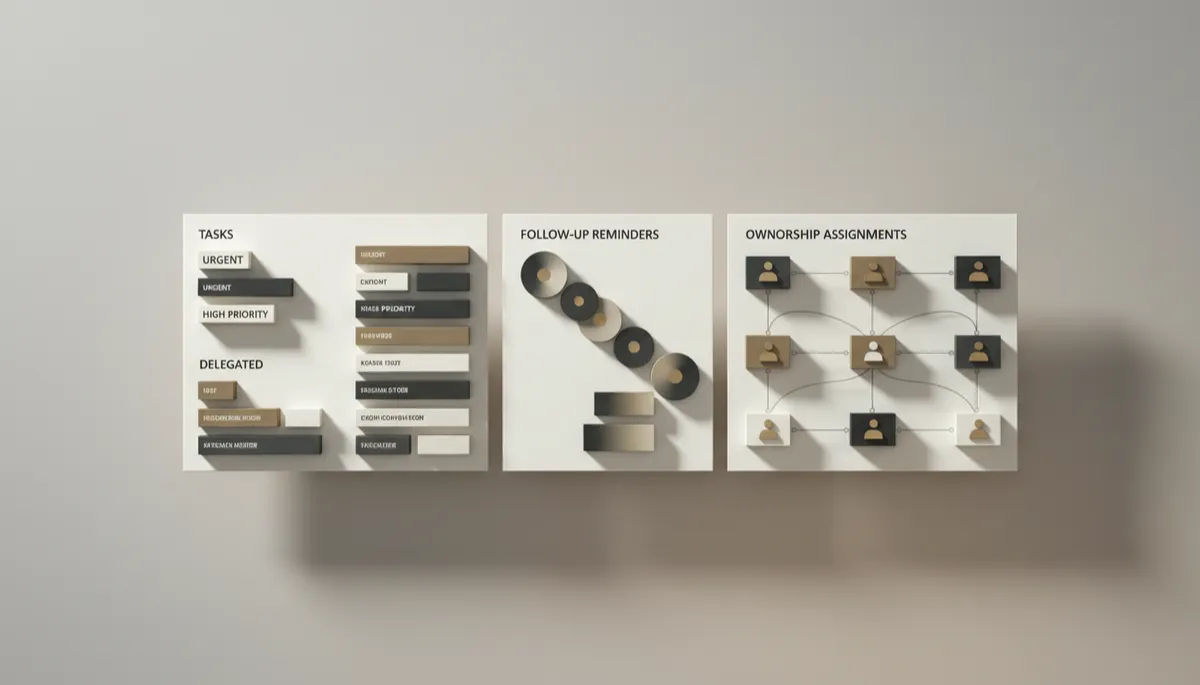
Structured systems transform scattered follow-ups into predictable, low-friction workflows.
8. Why Executives Become the Default Problem-Solver
In many organizations, the most capable person gradually becomes the default answer to every question. This is rarely intentional. It happens because:
Processes are undocumented, so people rely on the executive’s memory and judgment
Ownership is fuzzy, so raising issues to the top feels safer than deciding locally
The executive responds quickly, reinforcing the habit of escalation
High-performing people become trapped by their own competence. The better they are at solving problems, the more problems find their way to them. Without better business systems and executive support, this cycle continues until the executive’s day is filled with decisions that someone else could have made with the right structure in place.
9. Fragmented Communication and Operational Friction
Another root cause of the Invisible Labor Crisis is fragmented communication. Decisions and commitments are scattered across email, text, messaging apps, meeting notes, and hallway conversations. The result is operational friction:
People have different versions of the truth about what was decided
Key details are lost, so work must be redone or clarified repeatedly
Executives get pulled in just to re-state or confirm decisions
Strong operational support — including booking and scheduling, event planning, and vendor coordination — centralizes communication into reliable channels. It also ensures that decisions are captured, documented, and translated into action items, not left to memory or chat history.
10. Cognitive Bandwidth: The Most Underestimated Executive Resource
Time is easy to see on a calendar. Cognitive bandwidth is harder to measure but often more limiting. It is the mental capacity required to:
Hold complex situations in mind
Make high-stakes decisions with incomplete information
Think strategically instead of reactively
Invisible labor consumes cognitive bandwidth in small increments. The executive may only spend a few minutes on each decision or follow-up, but the constant context switching erodes deep focus. Protecting cognitive bandwidth is one of the most important goals of executive productivity and a core theme in Almost Anything Inc.’s work on the Invisible Labor Crisis.
11. How Better Systems Protect Executive Attention
Better business systems act as a protective layer around executive attention. They ensure that only the decisions that truly require senior judgment reach the executive, and that those decisions arrive with context, options, and recommendations. This often includes:
Standard operating procedures for routine activities, supported by virtual assistance and administrative support
Clear escalation paths so that only exceptions reach the executive’s inbox
A Personal Chief of Staff–style role that filters, prioritizes, and coordinates requests
This is where Almost Anything Inc.’s executive concierge services and VIP lifestyle management become strategic tools, not just conveniences. They create a buffer between the executive and the operational noise of both business and life, allowing attention to stay focused on high-value work.
12. Operational Systems: Consistency, Accountability, and Continuity
Strong operational systems create consistency and accountability. They define:
What needs to happen (the workflow)
Who owns each step (the responsible roles)
When it should occur (the cadence and triggers)
With this structure in place, accountability is baked into the system, not dependent on the executive’s personal oversight. Services like home & lifestyle management, property management, and luxury errand services from Almost Anything Inc. extend this principle into personal and household domains, creating continuity across all parts of a high-performer’s life.
13. Four Practical Examples: Hustle vs. Systems
Example 1: The Founder Coordinating Everything
A founder is building a fast-growing company while also managing travel, vendors, and personal responsibilities. Their day is a constant shuffle between investor calls, supplier issues, last-minute travel changes, and household logistics. They pride themselves on “keeping it all in their head,” but the cost is constant distraction and late-night catch-up work.
Hustle response: Work later, answer more messages, push harder. Systems response: partner with an operational support provider like Almost Anything Inc. to create structured lifestyle management, centralized booking and scheduling, and clear rules for travel, events, and vendor communication. The founder no longer coordinates every detail; they approve well-prepared plans.
Example 2: The Executive Interrupted by Small Decisions
A senior executive attempts to work on a strategic plan but is interrupted every few minutes: “Should we move this meeting?” “Which vendor do you prefer?” “Can you approve this small expense?” None of these decisions are large, but together they prevent deep work and contribute to decision fatigue.
Hustle response: Try to multitask faster and respond in real time. Systems response: establish decision guidelines, delegate categories of decisions to executive support and personal assistance, and route all non-critical approvals through a Personal Chief of Staff–style function. The executive focuses on strategy while the system handles routine choices.
Example 3: The Business Owner Managing Properties and Home Life
A business owner runs multiple locations while personally handling property maintenance, service appointments, and home-related logistics. They spend hours each week coordinating contractors, following up on repairs, and juggling schedules between work and family commitments.
Hustle response: Block more time on weekends to “get organized.” Systems response: leverage Almost Anything Inc. services for property management, home & lifestyle management, and vendor coordination. The owner defines standards and preferences once; operational support manages recurring responsibilities and escalates only exceptions.
Example 4: The High Performer Who Delegates but Still Manages Everything
A high-performing professional has an assistant and several team members. They delegate tasks frequently but still feel like they are managing every detail: checking in, clarifying expectations, chasing updates, and correcting small mistakes. Delegation has reduced some workload but not the mental load.
Hustle response: Try to organize more check-ins and status meetings. Systems response: shift from task-based delegation to ownership-based systems, supported by operational support and virtual assistance. Define clear outcomes, decision rights, and feedback loops. Over time, the professional becomes the architect of the system, not the manager of every task.
14. From Reactive Operations to Proactive Systems
Moving from reactive operations to proactive systems is not about adding more tools or hiring more people by default. More employees cannot automatically fix poor processes. More technology cannot fix unclear ownership. More productivity apps cannot eliminate unnecessary decisions. The shift requires:
Identifying where invisible labor is consuming time and attention
Designing workflows that minimize manual intervention and repeated decisions
Building support structures — such as executive concierge services, personal assistance, and VIP lifestyle management — that maintain those systems over time
In this model, operational support is not just about completing individual tasks. It is about creating an environment in which high performers can consistently operate at their best, with minimal friction and maximum clarity.
15. Why Operational Support Is More Than Task Completion
The most valuable operational support does not simply “do more things.” It:
Reduces cognitive load by owning categories of work end-to-end
Creates continuity so that knowledge and preferences are preserved over time
Builds accountability into the system, not just into individuals
This is the philosophy behind Almost Anything Inc. As an operational support partner, it helps clients offload not only tasks but entire areas of responsibility — from event planning and project management to home & lifestyle management. The goal is to turn time into value by ensuring that the client’s energy is invested where it has the greatest impact.
Key Takeaways
Hustle cannot compensate for broken systems. Working harder inside an inefficient structure only increases strain; it does not solve root causes of operational friction.
Invisible labor reveals operational inefficiency. The small, constant tasks and follow-ups that consume your attention often point directly to missing processes and unclear ownership.
Delegation is not the same as transferring ownership. Assigning tasks still requires you to manage the system; transferring ownership allows others to run the system on your behalf.
Executive attention is a critical resource. Protecting cognitive bandwidth is essential for high-quality strategic thinking and long-term decision-making.
High performers can be trapped by their own competence. The more capable you are, the more likely you become the default problem-solver unless systems redistribute responsibility.
Better systems reduce cognitive load. Clear workflows, documented preferences, and structured communication remove unnecessary decisions and follow-ups from your mental queue.
Operational support should create ownership, continuity, and accountability. The most effective support partners manage categories of work end-to-end, not just one-off tasks.
The goal is to create capacity for high-value work. The objective is not to eliminate hard work but to ensure that effort is focused where you create the greatest value.
Conclusion: You May Not Have a Productivity Problem — You May Have a Systems Problem
The Invisible Labor Crisis is not a story about people who are unwilling to work hard. It is a story about talented, driven individuals whose time and attention are quietly eroded by fragmented systems, unclear processes, and unstructured responsibilities. Most businesses do not need more hustle; they need better systems that transform invisible labor into visible, manageable workflows.
Success should not require executives, founders, and high-performing professionals to personally carry every operational detail surrounding their work and lives. When every problem, decision, and follow-up still routes back to the same person, the issue is rarely effort. It is the absence of an operational infrastructure that can hold complexity on their behalf.
Almost Anything Inc. positions itself in this gap — not as an errand company, but as an operational support partner that helps clients design and maintain systems around their professional and personal worlds. Through executive concierge services, personal assistance, virtual assistance, and comprehensive lifestyle management, it supports the shift from reactive hustle to proactive structure.
The real objective is not to avoid hard work or ambition. It is to ensure that your time, attention, and energy are invested where you create the greatest value — in the decisions, relationships, and strategies that only you can lead. If you suspect you do not have a productivity problem but a systems problem, exploring how an operational partner like Almost Anything Inc. can help redesign your invisible labor may be the most leveraged next step you can take.